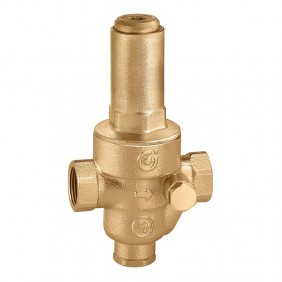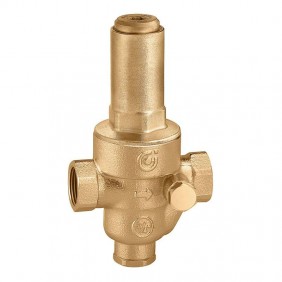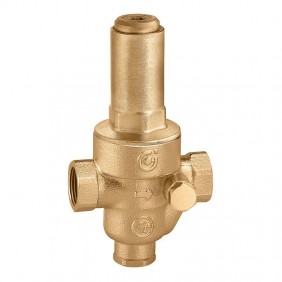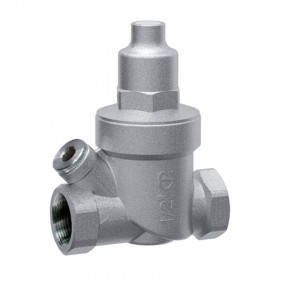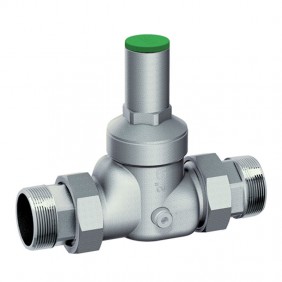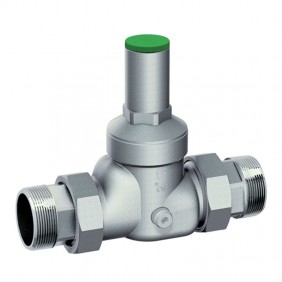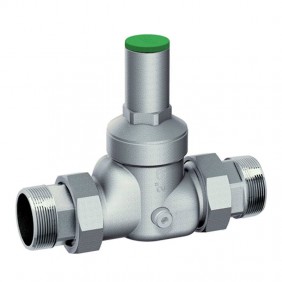
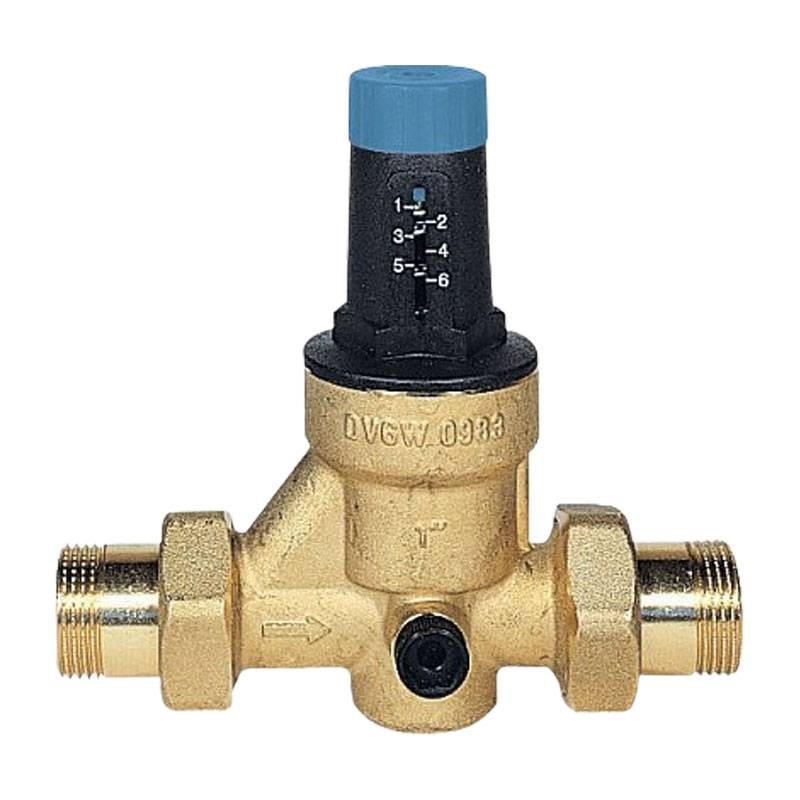
Watts DRVN Pressure Reducer M/M 3/4 Brass 0502520
Watts DRVN pressure reducer with the following characteristics:
- Connection: Male/Male
- Fittings: 3/4 inch
- Material: Brass
- Maximum upstream pressure: 25 bar
Patented diaphragm pressure reducer with compensated seat, with knob for adjusting outlet pressure and external graduated scale for easy reading of set pressure. Complete with pipe union fittings.
Features:
- Maximum upstream pressure: 25 bar
- Downstream (outlet) pressure: 1.5÷6 bar
- Downstream pressure adjustment (screw 4) clockwise rotation: increase pressure counterclockwise rotation: decrease pressure
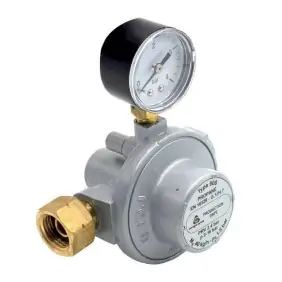
- Downstream pressure gauge (DRV-M only) gauge Ø50 scale 0÷6 bar
- Maximum operating temperature DRVN 30°C
- Maximum operating temperature DRV 60°C (30°C DVGW)
- Construction characteristics DRV and DRVN
- Body Sandblasted brass/CW617N
- Cap Sandblasted brass/(DRV) CW617N
- Reinforced technopolymer (DRVN)
- Brass Brass CW617N
- Inlet/outlet connections Brass CW617N
- NBR diaphragm with nylon cloth - KTW - W270
- NBR seal and O-ring KTW - W270
- Spring Galvanized steel
- Calibration screw and lock nut Brass CW617N
- Strainers Stainless steel
Pressure reducers are used:
In plumbing systems:
- to maintain constant water pressure in the distribution network downstream of the reducer
- to prevent excessive water withdrawals by controlling the pressure at the taps
- To keep the water pressure constantly below the maximum allowable value
In compressed air systems:
- to keep the pressure in the network constant, regardless of fluctuations in the pressure supplied by the compressors
Downstream of storage tanks or cylinders:
- To reduce and stabilize the pressure in the network that is normally lower
In addition to water, pressure reducers are also used for air and gas (neutral). DRV, DRVM, DRVN, DRVMN Series pressure reducers are of the compensated seat type. This means that the inlet pressure, acting on the two openings having the same cross section, is compensated and therefore exerts no force on the poppet pin system as the degree of opening of the reducer changes.
Instead, the outlet pressure acts on the diaphragm and thus on the pin-obturator system, which is thus subject to two opposing forces: that exerted by the outlet pressure, which tends to close the shutter, and that exerted by the spring, which tends to open it. The result is a behavior of the compensated seat reducer having the outlet pressure virtually insensitive to changes in upstream pressures.

Data sheet
- Type: Pressure reducers
- Connection: M/M
- Connections: 3/4 inches
: 4