
Have you planned to buy an air conditioner, but are undecided which one to choose? Looking for advice on which features to check before buying?
In this post we take you step by step towards choosing the most suitable air conditioner for your needs.

Nowadays, having an air conditioner in the rooms we live in is an almost obligatory solution.
Climatic conditions are changing abruptly. We are inching towards a tropical situation, which requires us, in increasingly humid summers, to cool and dehumidify the rooms in which we carry out our daily activities. This device can also be used in winter to heat homes and offices. The choice of the air conditioner to be installed must therefore be well thought out, and made following some indications that we will give you in this article.
Index:
- Choosing an air conditioner: BTU
- What air conditioner size do I need?
- Factors influencing BTU calculation
- Air conditioner energy class
- Indoor and outdoor unit
- Brands
Choosing an air conditioner: BTU
When choosing an air conditioner, the first thing to do is to understand the sizing of the machine in relation to the room in which it will be installed. Air conditioners measure their capacity in BTU (British Thermal Units): these indicate the thermal energy required to cool or heat a room.
The more BTU the unit has, the more it will heat or cool the area to be served. The calculation to be made to work out how many BTU we need must take into account a few variations:
- Room square footage
- Exposure to sunlight of ceilings
- Exposure to sunlight of walls
- Thermal insulation of walls
- Surface of windows and their exposure
- Outdoor and indoor curtains
What air conditioner size do I need?
When choosing the most suitable model, it is essential to first know the size of the room in which it will be installed, expressed in square metres. Simply multiply the width by the length of the room and multiply the result by 350 to obtain the BTU needed to cool or heat that room.
Let’s take an example. We have a room of about 25 square metres. On which model (in relation to BTU) should the choice of air conditioner fall? We multiply 25 by 350: the result is 8750. It means, therefore, that we will need a 9000 BTU machine to reach our goal. Below is a reference table:
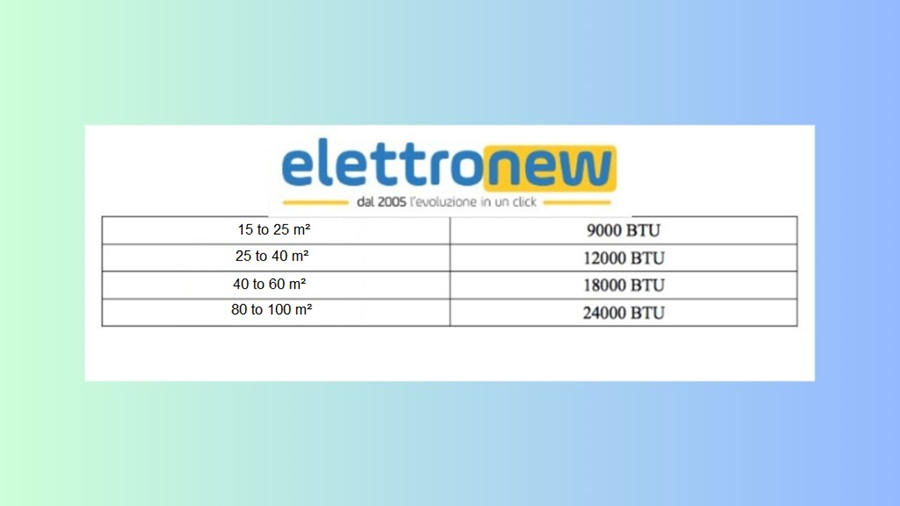
This is a mathematical, reliable formula. Beware, however. There are, as written in the list above, other factors to consider that could affect the choice of BTU.
Factors influencing BTU calculation
Let’s start with the light exposure of the room where the air conditioner will be installed. For example, in a room exposed to the sun all day, which is located on the top floor, the heat of the room will certainly be greater than in a room with little exposure to the sun and which is located in a flat on an intermediate floor. If the room is 25 square metres, we should, according to the table above, opt for a 9000 btu air conditioner. In the example case, however, it may not be enough to cool the room, and then the installation of a 12000 btu should be considered.

Another element to take into account is thermal insulation. If the room is insulated, it will be easier for the air conditioner to cool or heat the room. And, in this case, one could also opt for an undersized model compared to the btu one would normally choose.
Finally, when choosing the air conditioner, the size and light exposure of the windows must also be considered, as well as the presence of curtains, both for indoor and outdoor, that mitigate, in some way, the entry of the sun’s rays into the room.
Air conditioner energy class
When choosing the right model to buy, one must also pay attention to its energy class.
Some devices may have a relatively low price, but a poor energy class. The (negative) results of such a choice will then be seen in the electricity consumption and, consequently, in the high electricity bills we will have to pay.

Choosing an air conditioner with an energy class A, on the other hand, means generating considerable savings in the energy bill, even at a higher purchase cost of the unit.
Indoor and outdoor unit
It is well known that air conditioners consist of two units: an indoor and an outdoor unit. The outdoor units are all very similar. Depending on their size, they can be installed on the wall, using brackets, or on the floor, if the motor is very heavy.

If the outdoor space is small, it will be possible to use a multisplit, an outdoor unit to which up to four air conditioners can be connected. The indoor unit, on the other hand, can be wall-mounted (the classic split), cassette or ducted, i.e. recessed in the false ceiling, and console, with the possibility of both floor and wall installation.
Finally, there are also air conditioners without an outdoor unit, which have a smaller footprint than classical air-conditioners.
Brands
Finally, for the model we are going to install, the brand on which we are going to base our choice is also important.
On Elettronew you will find the best brands of air conditioner. A list made on the basis of accurate market research, which has taken into account above all the relationship between quality and price, which is the feature most in demand by all customers. And the prices of air conditioners, on our portal, are really advantageous for all brands.
You might also be interested in:
- How to remove air from ac system without vacuum pump
- The best air conditioners: Top 10 of 2024
- Air conditioner installation: Step by Step guide