
In this post we explain what an F-type residual current device is for and when to use it.
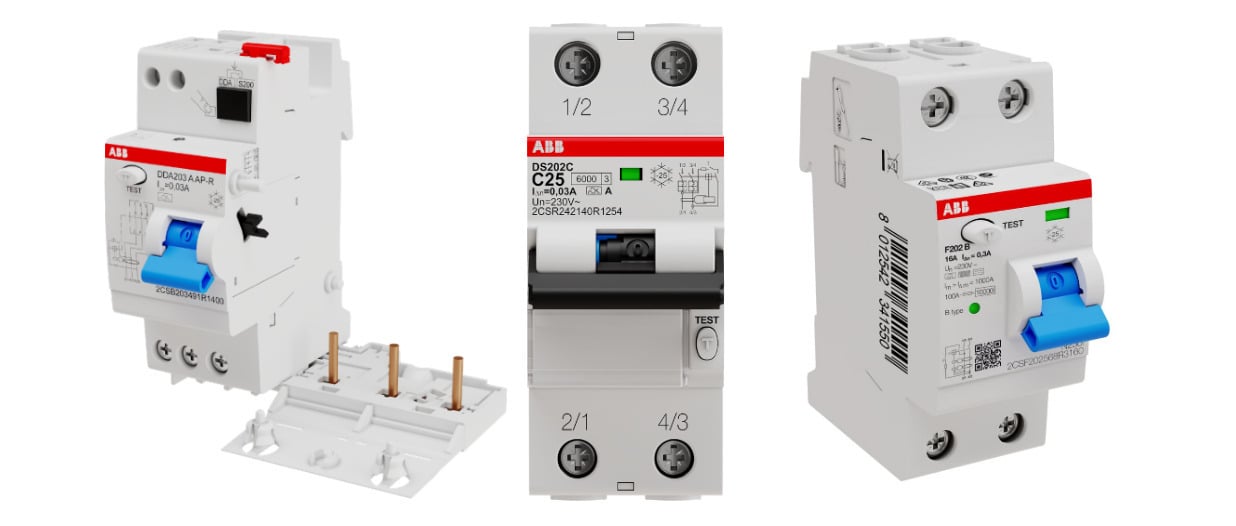
Residual current device Type F
Residual current devices are an essential component in domestic electrical installations. Present in practically all switchboards, they are positioned upstream of the domestic electrical circuit to protect the entire system from any faults on the power supply line.
In this post we will focus on a specific type of residual current device: the F-type, which is increasingly popular in residential electrical installations.
We will therefore explore the reasons for this growing preference by analysing its main characteristics in order to understand when to use it correctly.
Index:
- Residual current operated circuit breaker Type F and inverter motors
- When to use the residual current device type F
- Residual current device type F main features
Residual current operated circuit breaker Type F and inverters
In today’s world, we find a wide range of circuit protection devices, each designed to meet specific needs.
These include types AC, A, B and F, to which we pay particular attention in this article.

In modern flats, it is common to find a range of essential household appliances such as washing machines, dishwashers, hoovers, and air conditioners, all equipped with inverter motors.
This advanced technology offers improved performance while significantly reducing power consumption.
F-type residual current devices, where ‘F’ stands for frequency, are a response to the needs dictated by the spread of inverters. These devices are capable of detecting and handling high-frequency faults generated precisely by inverters.
In contrast, traditional residual current devices are not able to detect this specific type of fault.
Their introduction represents a step forward in the protection of domestic electrical installations, guaranteeing greater safety in a context where the use of inverters is increasingly widespread.
When to use the residual current device type F
Let’s talk about the inverter motor, a technology that is now widespread in most domestic appliances. This device, technically known as a single-phase frequency converter, plays a crucial role in regulating the speed of an electric motor by adjusting the voltage and frequency of the power supply. Its main function is to adapt the power of the motor to the specific needs of the application, thus enabling more efficient and cost-saving operation.

The single-phase inverter generates current by superimposing components of different frequencies, ranging from 10 Hz (corresponding to the motor frequency) up to 1000 Hz (the switching frequency). This ability to vary the frequency of the power supply allows the motor speed to be controlled precisely and flexibly, adapting it to various load and working conditions.
In the context of using single-phase inverters, it becomes crucial to ensure the safety and protection of electrical installations. For this purpose, the F-type residual current device is particularly suitable. This type of circuit breaker is specially designed for applications where a single-phase inverter is present, offering effective protection against faults and short circuits that could occur in the system.
The use of a residual current device, such as those offered by reputable brands like Bticino, provides an additional level of safety and reliability in the installation and operation of single-phase inverters, ensuring the protection of domestic appliances and the safety of users.
Residual current device type F main features
F-type residual current devices, from a technical and performance point of view, are positioned between A-type and B-type residual current devices. They have, consequently, certain characteristics of their own, which are:
- High resistance to transient disturbances and overvoltage of atmospheric origin, thus avoiding untimely trips that would damage inverter motors
- They correctly detect all types of leakage identifiable by type A, also providing adequate protection in the presence of multi-frequency fault currents
- They trip even in the presence of superimposed DC, up to 10 mA
Ultimately, therefore, installing an F-type residual current device upstream of the system will serve to protect all household appliances with an inverter motor.
This type of residual current device is therefore a valid design and installation solution when maximum protection is required for the above-mentioned devices.
You might also be interested in:
- Double pole switch wiring: how to install it
- Bticino living now catalogue: complete offer 2024
- Definition of home automation: meaning in 2024