
In this post we will explain the differences between button, multiway switch, switch and intermediate switch, very similar control devices.
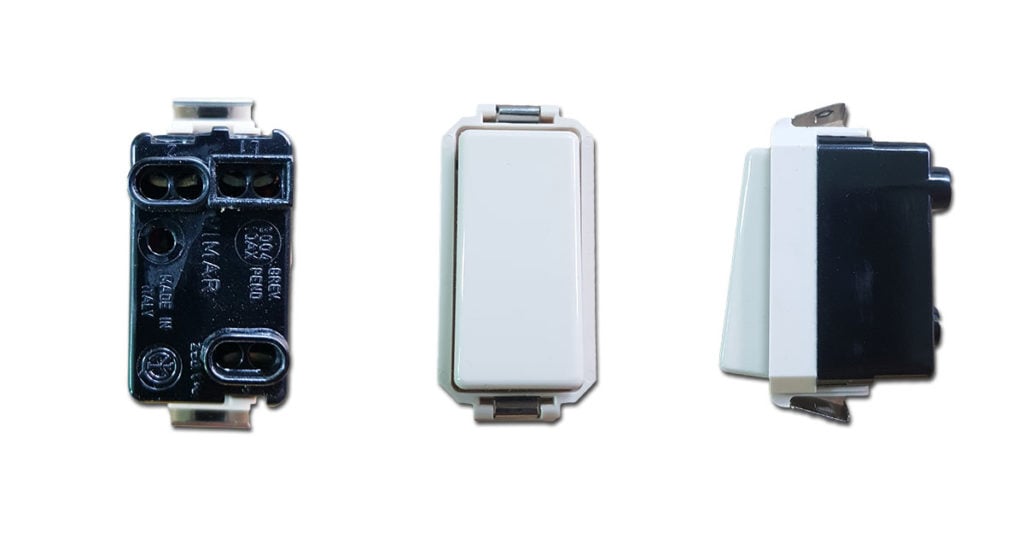
The button, switch, multiway switch and intermediate switch are particularly similar components in appearance, but with totally different functions.
Many differences are hidden in the back, as can be seen from the picture, buttons, switches, multiway switches and intermediate switches have a different terminal arrangement.
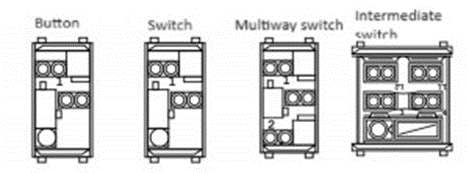
We now explain in detail the types and functionalities of each individual component.
Index:
- Switch
- Double pole switch
- Button
- Multiway switch
- Intermediate switch
- Differece between multiway and intermediate switch
- Rocker and axial
Switch
The switch has the function of opening or closing a circuit, acting on the phase of our system. The neutral is connected directly to the light point, the phase, on the other hand, first reaches the switch, which interrupts it, and then the lamp.
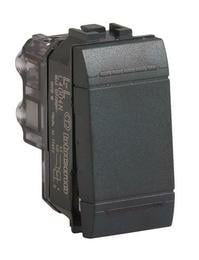
The above circuit can be reproduced by using a single-pole switch, as the latter acts on a single pole, i.e. the phase electric cable (brown or black) which is used for the light points.
Double pole switch
The double-pole switch performs the same function as the single-pole but interrupts both poles (phase and neutral wire) for greater protection of the load. In fact, its use is recommended for appliances with a high-power consumption (e.g. oven, water heater, hob, washing machine and other large appliances.
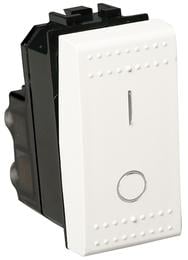
The double-pole switch also facilitates maintenance of the equipment to which it is applied, because it completely isolates them, making routine and extraordinary maintenance completely safe and risk-free. It can also be distinguished from the single-pole switch by the I and O shown in the photo (or On Off).
For more information on mounting two-pole switches, please read the post: How to wire a double-pole switch.
Button
The button has a very similar function and application to the switch. The button, however, unlike the switch, returns to its original position once released. The electrical connections are the same as those of a switch, but the button has two different positions:
- NO (normally open)
- NC (normally closed)
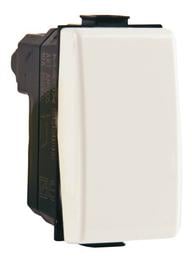
If it is normally open, the current is circulating; if it is normally closed, the current is cut off when the button is pressed. The button is mostly used for bells (ringing), for opening gates, gates, or to switch on a lamp from several points using a relay type.
Multiway switch
The multiway switch is a switch capable of controlling one lighting points from two different positions. The multiway switch, instead of interrupting the current flow of an electric cable, diverts the flow to another cable, bringing the phase to another multiway switch.
Two multiway switches allow the user to control a lamp from two points. Everything you need to know about mounting a multiway switch is written in our exclusive post: Multiway switch: Lighting a lamp from two points
Intermediate switch
The intermediate switch is used when we choose to control one or more lamps from 3 or more points and is always preceded by a multiway switch. For example, in a system controlled by three lighting points, the intermediate switch must be mounted in the middle of two multiway switches.
Difference between multiway and intermediate switch
In essence, therefore, the multiway switch is intended to control the lighting points from two different locations in a room. From this it is clear why the multiwayswitch should always be used together with another multiway switch, so that it can control, by switching on or off, the light from different locations.
At the rear, unlike the simple switch, the multiway switch has three terminals. On one side is the phase cable which is inserted into the terminal marked with the letter L and extended to the other multiway switch to be used in pairs. Similarly, another cable runs from the second terminal of the first multiway switch and connects to the second terminal of the second multiway switch. Finally, there is the last terminal of the second multiway switch, which must be connected to the last terminal of the first multiway switch.
The intermediate switch is a more complex type of switch. useful if one decides to control a light from three spatially differently located points. To manage three light control points for the same lamp, we will need two multiway switches and an intermediate switch.
Rocker and axial
Buttons, multiway switches, switches and intermediate switches can also be axial and rocker, peculiarities that do not affect their operation but simply their aesthetics. Let’s discover their features in detail:

- Rocker: when pressed it remains in the position we gave it immediately after the action.
- Axial: when pressed it always returns to its initial position.
You might also be interested in:
- Dimmable meaning: Definition and applications
- Bticino living now catalogue: The complete offer
- Meaning of home automation: Definition in 2024